Menu
Close



The mobility industry is undergoing a seismic transformation, transitioning from traditional vehicle manufacturing to an integrated, technology-driven ecosystem. As this shift accelerates, brands face a delicate balancing act: embracing emerging EV technologies whilst preserving the legacy strengths, and meeting the existing needs, of ICE expertise. This dual challenge is reshaping how companies position themselves in an increasingly complex and competitive market.
How can brands maximise the opportunities of new technologies without alienating existing markets? Can they build credibility in sustainable innovation whilst staying true to their heritage? To shed light on these complex challenges, our Strategy Team conducted an in-depth analysis of five Tier One suppliers. We examined their brand positioning, adaptation strategies, and messaging approaches in the context of this shifting mobility paradigm.
In this blog post, we'll share our key findings and insights, offering a unique perspective on how brands can successfully navigate this transformative period. Whether you're an industry veteran or a newcomer to the mobility sector, our analysis will provide valuable insights into effective brand positioning strategies for the future of mobility.
Redefining value and experience, Charlotte Bloomfield
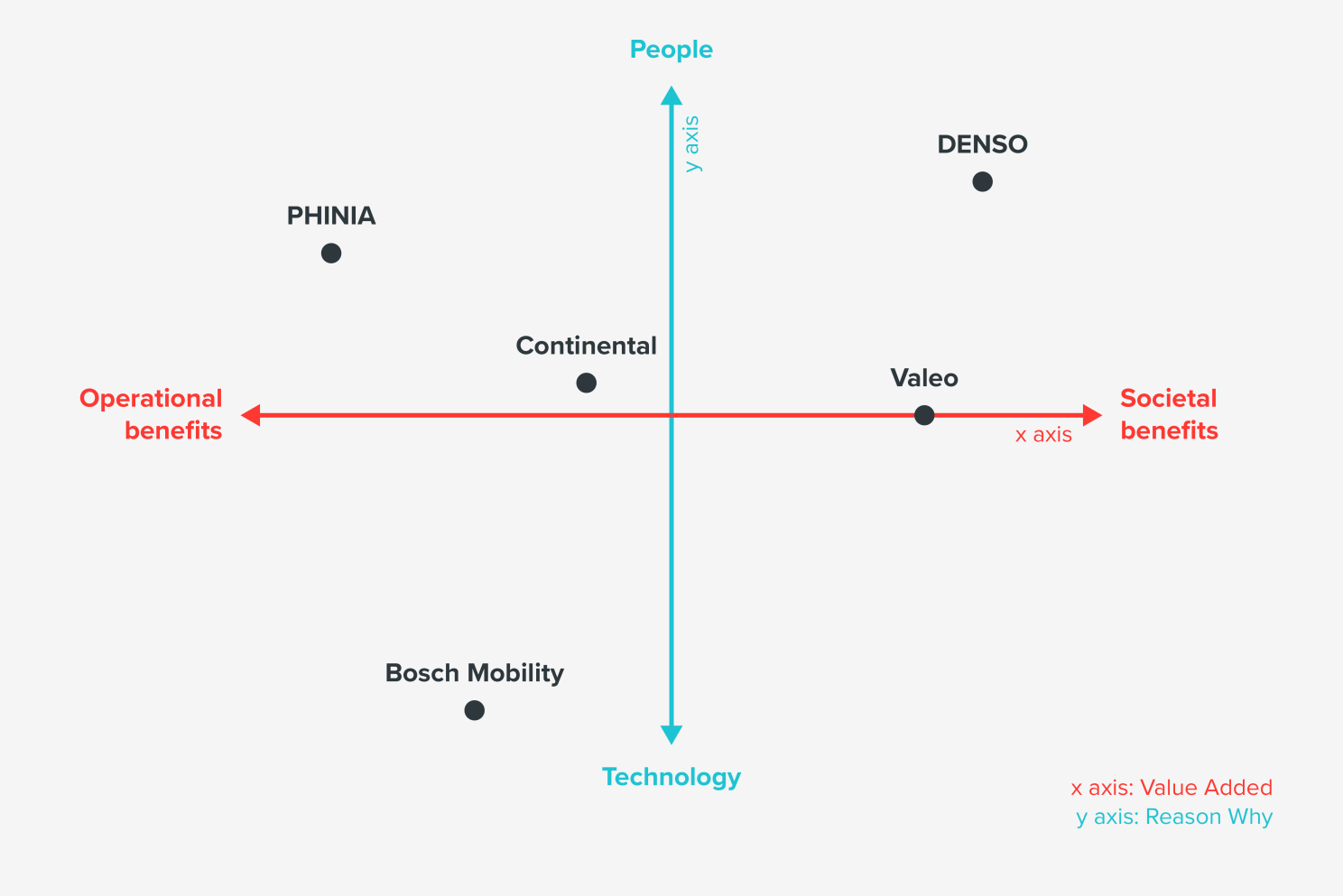
Based on our findings, we created a brand map to plot each supplier's approach, providing a clear visualisation of their messaging strategies within the context of this rapidly transforming industry. This frequently exercised activity gives us a clear bird's-eye view of how brands are positioning themselves externally and where gaps and opportunities exist.
The x axis- a more holistic perspective on adding value
The analysed brands communicated product and service benefits along a shared spectrum (see the 'x' axis in figure 1), emphasising value through operational efficiency – a long-standing USP for component suppliers. Traditionally, 'value' focused on cost reduction, process optimisation, and mass production. Now, it encompasses broader societal benefits such as reducing carbon emissions, enhancing urban mobility, and supporting equitable transportation access.
Aligning with global ESG trends and the push for net-zero economies, broadening brand communications along this spectrum allows suppliers to address climate change, urban congestion, and other important, holistic factors. This focus on social facets builds trust, fosters collaboration with automakers and stakeholders, and strengthens brand differentiation in a competitive, purpose-driven marketplace.
The y axis- expanding on experience
As automotive suppliers shift their brand narratives to align with the evolving mobility landscape, the focus on customer experience has remained constant. The end-customer experience has long been the 'reason for being' for suppliers across the value chain. However, whilst customer experience remains central to brand positioning today, suppliers must adapt their messaging to address changing attitudes towards mobility and the influential role of technology.
Some brands have chosen to broaden their perspective on customer experience by emphasising the creation of 'mobility wellbeing' as a societal benefit of their products. Others focus on delivering safer, more efficient, and comfortable experiences through innovative technologies. This realignment reflects how suppliers' 'reasons why' now mirror broader changes in customer needs and expectations towards mobility.
Brands under the spotlight
Let's examine some brands in detail. Valeo and DENSO adopt a forward-thinking stance on the mobility ecosystem, emphasising how their products and services benefit society at large. Valeo, for instance, positions itself as a 'technology company' committed to industry transformation. Their people-centric messaging highlights their role in advancing mobility for societal good, focusing on wellbeing and safety.
In contrast, PHINIA , Bosch Mobility, and Continental emphasise the operational benefits of their offerings. PHINIA, an automotive solutions provider, underscores the efficiency, performance, and reliability of their products. This approach builds trust and demystifies new technologies in an industry with varied adoption rates. Whilst PHINIA uses the term 'mobility' sparingly, they frame their contributions as part of a 'sustainable tomorrow'. Their messaging strategy balances innovation with a commitment to minimising societal impact, aiming to enable customers to create a sustainable future.
Authenticity Is Key: Staying True While Adapting to Change, Mark Dale
The mobility landscape is evolving rapidly, challenging brands to balance their legacy strengths with the demands of a new era defined by shifting customer expectations, technological advancements, and sustainability imperatives. Companies like Bosch Mobility, Continental, DENSO, PHINIA and Valeo are navigating this complex terrain, each charting their own course.
It's crucial to understand that there's no 'wrong' position on our brand map. Success doesn't hinge on choosing between holistic societal benefits or operational efficiencies. Rather, it lies in clear differentiation and a marketing communications strategy that authentically and consistently delivers on your chosen positioning. The key is ensuring your approach aligns your business's future direction, strategic goals, and unique brand identity, supported by robust proof points and data.
At palmerhargreaves, we partner with clients across the entire mobility ecosystem – from Tier One suppliers and Smart Grid providers to remarketing companies and autonomous driving innovators. Our expertise lies in helping brands define and communicate a clear, consistent positioning in this dynamic marketplace. We understand the challenges of adapting to change whilst staying true to your core values.